

Cr Nh3 6 No3 3
 Chemical structure of [Cr(HiiO)half-dozen](NO3)3 | |
 | |
| Names | |
|---|---|
| IUPAC proper name Chromium(Three) nitrate | |
| Other names Nitric acid, chromium(3+) salt | |
| Identifiers | |
| CAS Number |
|
| 3D model (JSmol) |
|
| ChemSpider |
|
| ECHA InfoCard | 100.033.550 |
| PubChem CID |
|
| RTECS number |
|
| UNII |
|
| United nations number | 2720 |
| CompTox Dashboard (EPA) |
|
| InChI
| |
| SMILES
| |
| Backdrop | |
| Chemic formula | Cr(NO3)3 (anhydrous) [Cr(H2O)6](NOiii)3•3H2O (nonahydrate) |
| Molar mass | 238.011 g/mol (anhydrous) 400.21 g/mol (nonahydrate) |
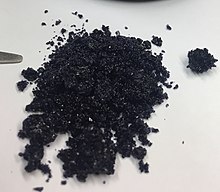
| Appearance | Blueish-violet crystals (anhydrous) Purple crystals (nonahydrate) |
| Density | 1.85 one thousand/cm3 (nonahydrate) |
| Melting signal | 60.06 °C (140.11 °F; 333.21 K) nonahydrate |
| Boiling signal | > 100 °C (212 °F; 373 K) (decomposes) |
| Solubility in water | 81 g/100 mL (20 °C) |
| Hazards | |
| NFPA 704 (fire diamond) | iii 0 one OX |
| Wink betoken | Non-flammable |
| Lethal dose or concentration (LD, LC): | |
| LDl (median dose) | 3250 mg/kg (rat, oral, nonahydrate) 110 mg/kg (mouse, oral)[one] |
| Safety data sheet (SDS) | Oxford MSDS |
| Except where otherwise noted, information are given for materials in their standard state (at 25 °C [77 °F], 100 kPa). Infobox references | |


Chromium(Iii) nitrate describes several inorganic compounds consisting of chromium, nitrate and varying amounts of h2o. Almost mutual is the dark violet hygrosscopic solid. An anhydrous greenish form is also known. Chromium(III) nitrate compounds are of a limited commercial importance, finding some applications in the dyeing industry.[2] It is common in bookish laboratories for the synthesis of chromium coordination complexes.
Construction [edit]
The relatively complicated formula - [Cr(HtwoO)6](NO3)3•3H2O - betray a simple structure of this textile. The chromium centers are bound to six aquo ligands, and the remaining volume of the solid is occupied by three nitrate anions and three molecules of water of crystallization.[3]
Properties and grooming [edit]
The anhydrous salt forms green crystals and is very soluble in water (in contrast to anhydrous chromium(III) chloride which dissolves very slowly except nether special conditions). At 100 °C it decomposes. The red-violet hydrate is highly soluble in h2o. Chromium nitrate is used in the production of alkali metal-free catalysts and in pickling.
Chromium nitrate can exist prepared by dissolving chromium oxide in nitric acid.[2]
References [edit]
- ^ "Chromium(3) compounds [as Cr(III)]". Immediately Dangerous to Life or Health Concentrations (IDLH). National Constitute for Occupational Safety and Health (NIOSH).
- ^ a b Anger, Gerd; Halstenberg, Jost; Hochgeschwender, Klaus; Scherhag, Christoph; Korallus, Ulrich; Knopf, Herbert; Schmidt, Peter; Ohlinger, Manfred (2000). "Chromium Compounds". Ullmann's Encyclopedia of Industrial Chemical science. Weinheim: Wiley-VCH. doi:10.1002/14356007.a07_067.
- ^ Lazar, D.; Ribár, B.; Divjaković, V.; Mészáros, Cs. (1991). "Structure of Hexaaquachromium(Iii) Nitrate Trihydrate". Acta Crystallographica Department C Crystal Structure Communications. 47 (five): 1060–1062. doi:10.1107/S0108270190012628.

Cr Nh3 6 No3 3,
Source: https://en.wikipedia.org/wiki/Chromium(III)_nitrate
Posted by: guzmanjudid1974.blogspot.com
0 Response to "Cr Nh3 6 No3 3"
Post a Comment